On a cool June evening in 1973 at the Royal Court Theatre’s tiny Upstairs space in London, you could have watched the very first performance of Richard O’Brien’s They Came From Denton High, which later became The Rocky Horror Show. It was conceived as an affectionate homage to B-movie horror and sci-fi and planned to run for just three weeks. O’Brien, a jobbing musical actor known for Hair and Jesus Christ Superstar and who was awaiting his big break, had recently shaved his head in an act of defiance at the traditional casting culture in theatre at the time.
When casting began for the show, Tim Curry, a friend of O’Brien’s from their roles in Hair, walked into the audition and sang Tutti Frutti in a thick German accent, selling director Jim Sharman on the spot.
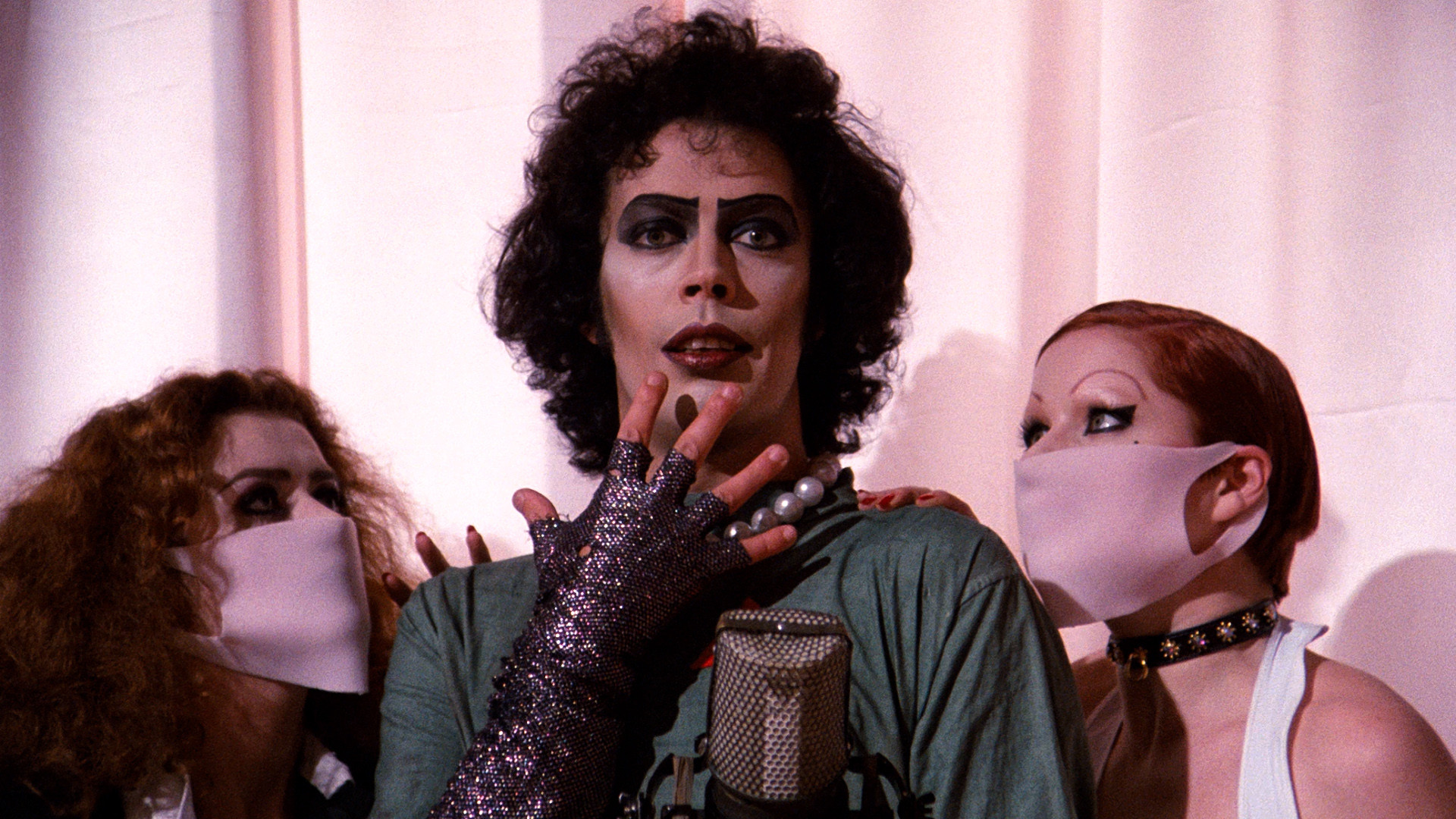 Tim Curry as Frank-N-Furter
After the stage show had achieved more success than initially thought and a feature film was in the works, English rock legend Mick Jagger was in contention for the part of Frank-N-Furter. Director Jim Sharman almost buried the whole production over his insistence on keeping Curry - and the studio executives offered him a $10 million budget if he cast Jagger and other rock stars, but he refused and the budget was shrunk to $1.5 million. This proved to be an excellent decision, giving us Curry’s immaculate performance and the show its delightfully cheap charm. Sharman did, however, give us the appearance of Meat Loaf, who, long before his Bat out of Hell fame, was a musical aficionado and was delighted to succeed in his audition to play Eddie.
The film shoot itself was infamously a nightmare. At Bray Studios just outside London, the film was shot with a combination of wet, outdoor sets, unheated Victorian gothic castles, and a rushed schedule. Susan Sarandon (Janet) had no place to stay and was sofa-surfing among friends in London while filming, and Barry Bostwick (Brad) recalls being sprayed with ice-cold water between takes of the pool scenes.
Yet the result of this damp miserable filming is what I contend is one of the best soundtracks in musical film history. Science Fiction/Double Feature is O’Brien’s love letter to everything he took inspiration from for the film, a catalogue of B-movies from the 30s to the 60s, name-checking Flash Gordon, Forbidden Planet, The Day the Earth Stood Still, and even King Kong. The Time Warp is critical to the film’s success - it invites the audience to participate, always triggers laughs when the criminologist joins in, and gives the film a vaudevillian energy. Touch-a, Touch-a, Touch Me is Janet Weiss’s breakthrough but nicely encapsulates the film’s overall ethos of sexual empowerment and liberation.
These themes of sexual exploration seen through a 2026 lens are of course not without controversy, as neither is O’Brien himself. Conversations around consent, sexual predation, and the conflation between cross-dressing, transvestites, and transness are real, and it is often questioned whether the film still holds up. But viewing the film through a 2026 lens may miss its reason for existing. When the film initially flopped on release, the reason it found the immortality it enjoys today was from people who attended midnight screenings, dressed up as Frank-N-Furter, sang along to the soundtrack, and created an underground Rocky Horror community. For someone who felt unrepresented and ignored in the 1970s, seeing Tim Curry’s unapologetic performance may have provided an exhilarating glimpse into a world in which they could express themselves without shame. Expecting a scrappy glam-rock homage to speak in modern terminology is ignoring the cultural reality of its creation in the 1970s - O’Brien and Curry were simply throwing a door open for the weird to be unapologetic.
Both Curry and O’Brien went on to carve out eclectic legacies - Curry, who recently passed away, collected a range of roles to his name, including Annie’s Rooster, Clue’s Wadsworth, It’s Pennywise, and Spamalot’s King Arthur (an Eric Idle production, another English icon). Curry said that Rocky Horror “didn’t help casting at all” and found that he had to stay on his feet to prove his worth was more than just his breakout role. Richard O’Brien later wrote Shock Treatment in 1981, a non-canon follow-up to Rocky Horror, featuring Brad and Janet as the only continuing characters. He also hosted the game show The Crystal Maze, a childhood favourite of mine. Both men worked hard to prove they were more than Frank-N-Furter and Riff Raff, yet the legacy of Rocky Horror is that it gave them (and generations of nonconformists) permission to be exactly who they were. That’s why, despite acknowledging the film as a product of its time, I can’t disown it.