I recently logged my 6,000th Daylio entry. I have been using the app since August 2018, when I was twelve: over eight years of entries, averaging just over two a day. I now have a record of my life stretching from the start of secondary school to my final year of university.
Some of the first entries are barely entries at all. They are mostly evidence that I had downloaded a new journalling app and was enjoying pressing its buttons. There are now thousands of these tiny moods, activities, one-line summaries and occasional paragraphs about days I would otherwise forget. My diary covers school, friends, family, moving house, university, exams, relationships, and so many past thoughts that I may sometimes prefer to forget.
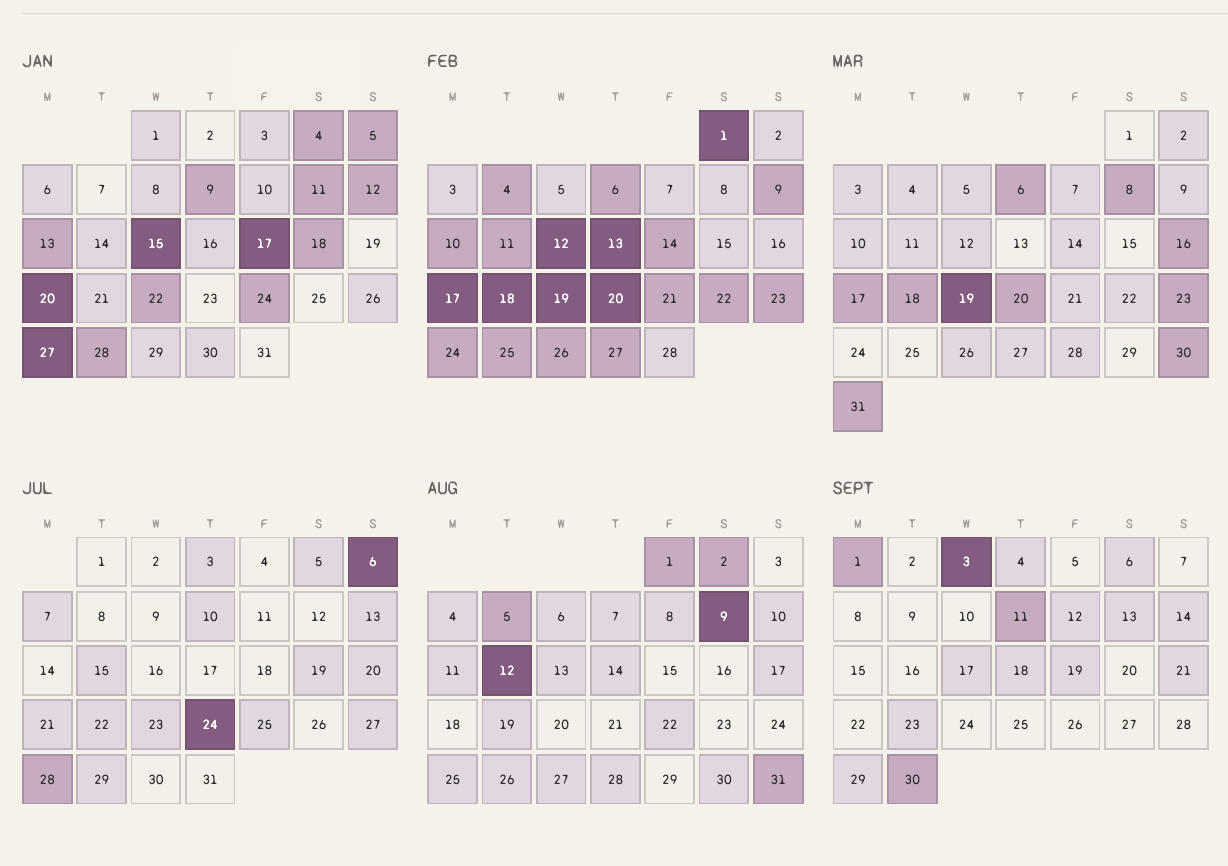 A random selection of moods in calendar view
Your journal is for yourself
When some people imagine journalling, they often picture a leather notebook, a fountain pen, and a candlelit room. When some people imagine a diary, they think of something that has to be polished, publishable, like a memoir. I disagree with both of these. If you hold yourself to such a high standard, you would write enthusiastically for three evenings, miss the fourth, and then feel guilty every time you see the notebook for the next six months.
I use the app Daylio, which is specifically designed to allow ‘bad’ diary entries. I can literally log a day as ‘Tired’ and write ‘played games’ and that could be it. Sure, it’s not a very useful data point, but it’s a journal entry nonetheless, and representative of my mood at that time.
Missing one day does not destroy the journal - there is absolutely nothing wrong with filling it in the day after, or the week after. The ‘day’ streak counter is only useful while it helps you write - do not treat it as a gamified streak you have to keep! The very very last thing a journal should ever be is more homework or stress in your life. It can be an outlet for your most private thoughts and moods, or it can be just a factual record of what you did. You do not have to write every single thing that happened, every single meal you had, every single person you saw. You can just log how you went to bed feeling, and that’s perfectly okay.
A day doesn’t need to be just one mood
Six thousand entries does not mean I have journalled for six thousand days (that number is only 2,936). It means I often make several entries in one day. This comes back again to the idea of a loose structure - you don’t need to limit yourself to one entry per day. Our moods change frequently! You can wake up feeling terrible and have a shockingly good day, or the inverse.
Reducing an entire day to one averaged mood is a ridiculous compression, of course. If you slept terribly but had a great evening, that ‘meh’ day may be very different to a completely boring day later in the year.
But that’s the amazing thing about keeping a journal, and in this case a digital one - your journal is yours to keep and analyse if you want to. There are so many cool stats you can get from the sheer volume of data that builds up.
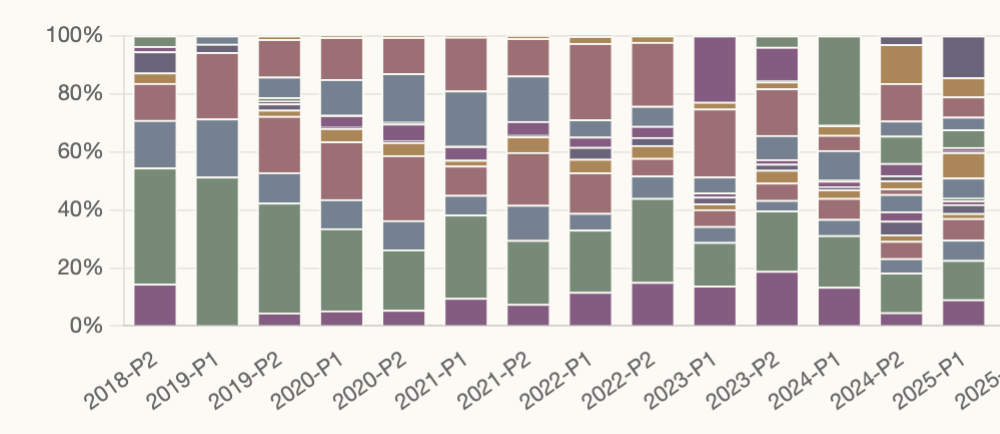 A stacked bar chart showing the proportion of entries mentioning different people in my life
A journal is an index
A short entry doesn’t need to record the entire day - it only needs to contain enough information to retrieve the memory later.
For example, take this real entry from 17 August 2022:
Had lunch which was feta cheese pie, and went for dog walk with Granny. Watched WILTY
It sounds meaningless. But for me, reading it back now, I can remember the exact route we took, the weather, the conversation I had with my granny that day, and all provoked just by the memory - something I would never have thought about again if I hadn’t written it down.
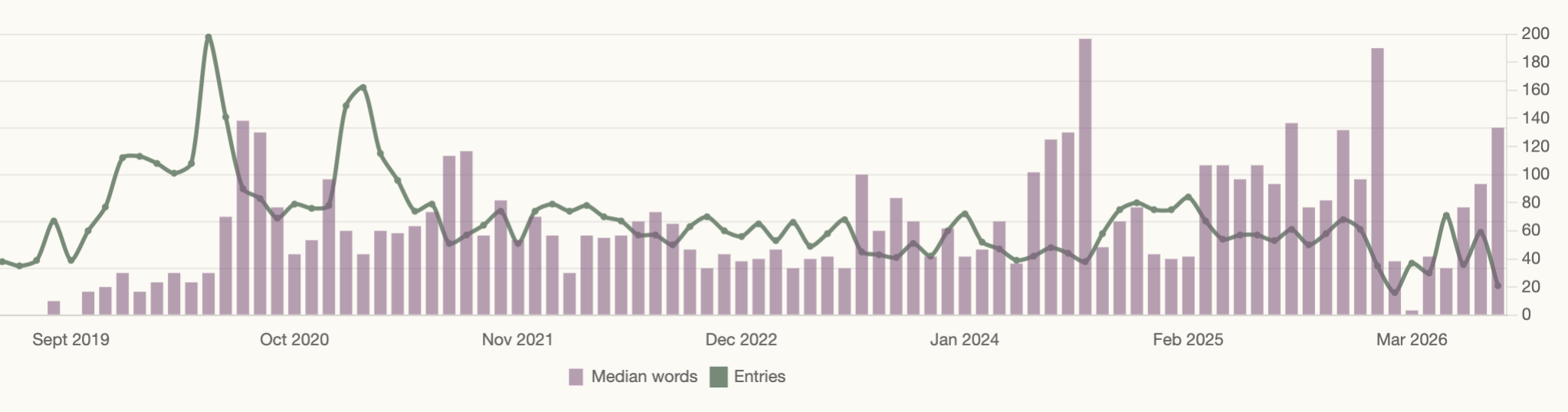 My entry length over time
A journal is not a recording of your entire life; it is just an index to help you retrieve memories that the human brain is extraordinarily good at keeping but hiding from itself.
What 6,000 entries can tell me
Eight years of entries also gives me a ridiculous amount of hindsight. If you find yourself falling into patterns, negative or positive, having past data makes these incredibly easy to track.
A terrible evening is often followed by a completely ordinary morning, and a week that felt utterly endless becomes four red squares surrounded by a sea of improving yellows and greens. This is useful knowledge to have when you are stuck spiralling inside one of the squares!
There are of course entries that I would rather keep private - not necessarily scandalous - just unfinished, or containing a view that past me held, that present me no longer agrees with. But I don’t go back and edit past entries - because I find it really interesting to see the progression of thoughts. We are inherently unreliable narrators of our own lives. Having a record written before I knew what happened next gives me something to think about - if you have a place where you can be as brutally honest as you can about everything, looking back on it later is extraordinarily insightful.
Here are some fun and slightly random insights I found from analysing the last eight years of my journalling data. (Obviously, this is not a scientific study, and is based on a very personal dataset.)
-
Out of 805 days in my history which started off negatively, 42% of them improved before the end of the day, and 78% of them improved by the end of the week. My present mood is surprisingly bad at predicting the future!
-
97.6% of days including ‘cinema’ or ‘theatre’ ended Good or better. Even after controlling for month and weekday, the adjusted lift was +1.03 mood points
-
Saturdays are my best day of the week, ending positively 77.8% of the time, beating every weekday
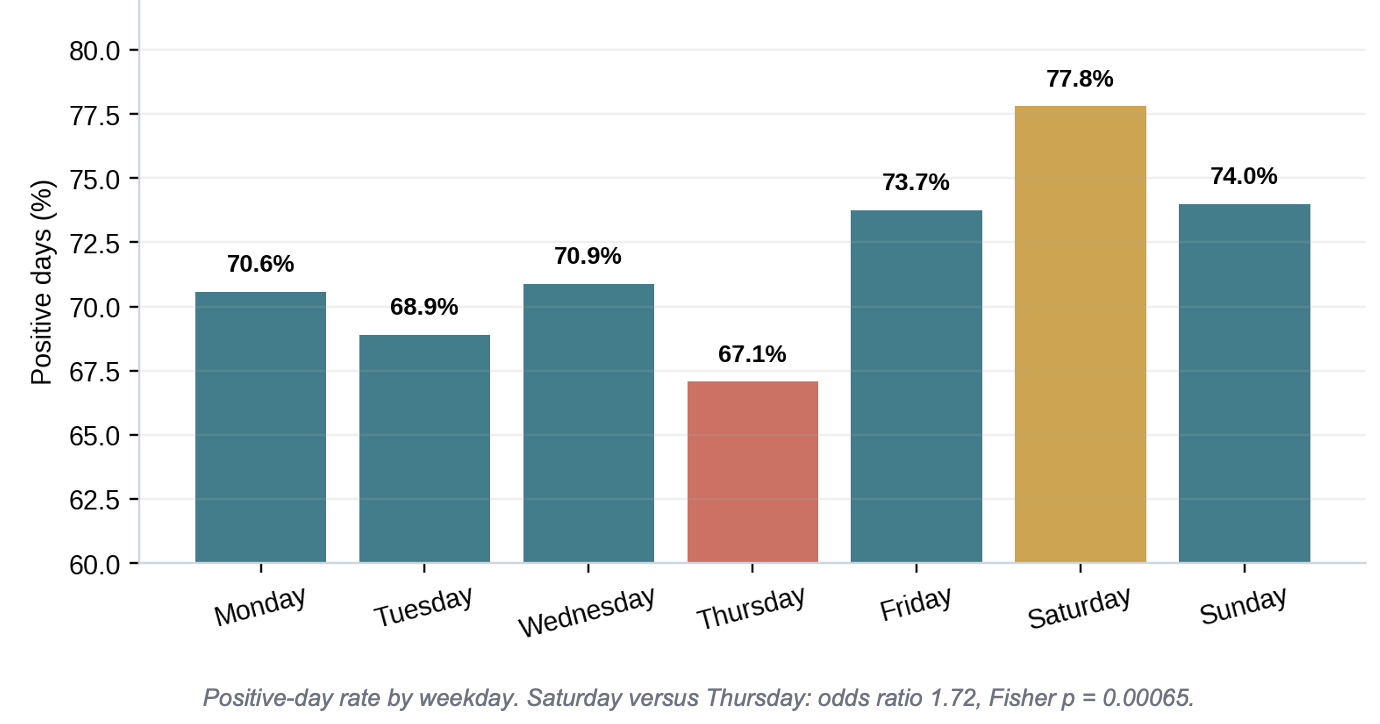 Saturdays are noticeably better than weekdays, with Thursdays coming last
-
One of the more useful things I discovered is that while socialising improves my mood, being alone doesn’t seem to be a problem. ‘Alone Time’ days were positive 78.5% of the time - what seems much worse is having nothing to do: bored or low-structure days hover just below the 50% positive mark. I am often perfectly content to spend the day by myself provided I have a plan for it.
-
Because of how Daylio works, we can also analyse the time of day the entry was written at!
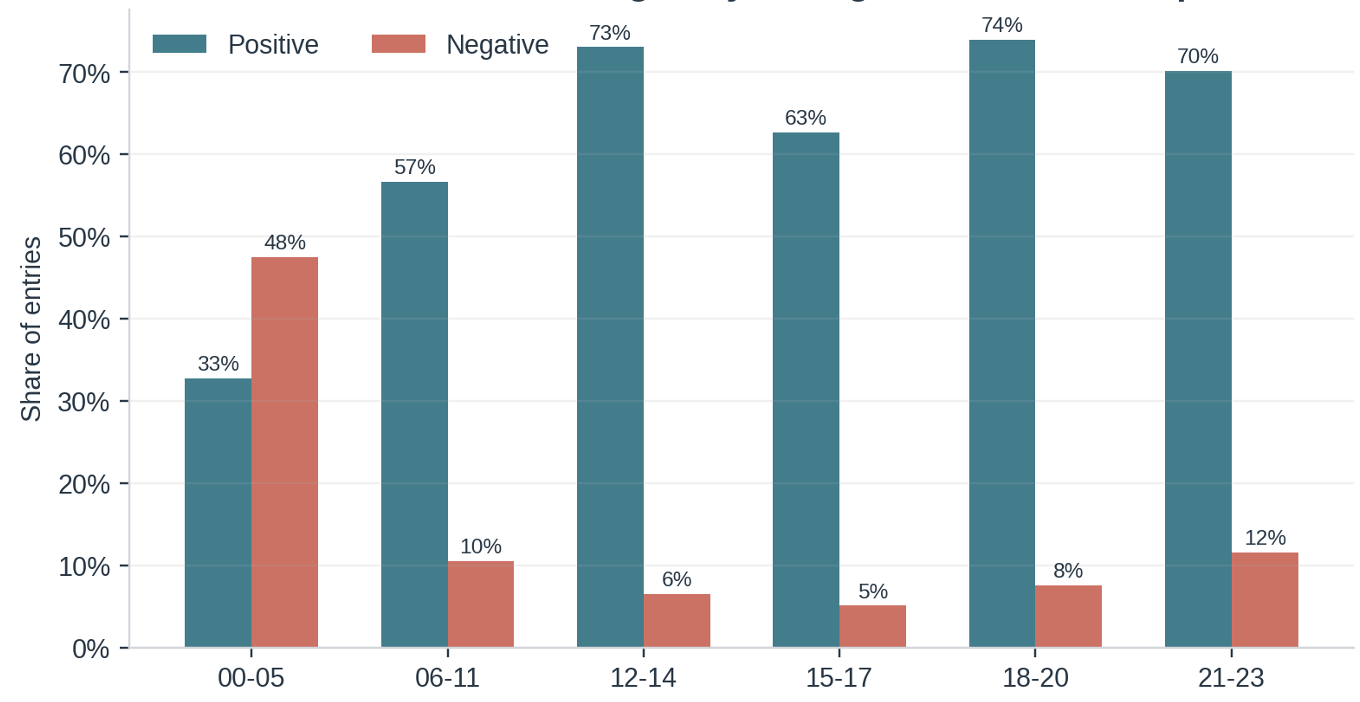 My late-night entries are much more negative than the ones I write during the day
- I grouped Saturday activities into five broad categories: being rested, eating something proper, seeing people, going outside and doing something entertaining. Saturdays containing four of those ingredients were positive about 95% of the time
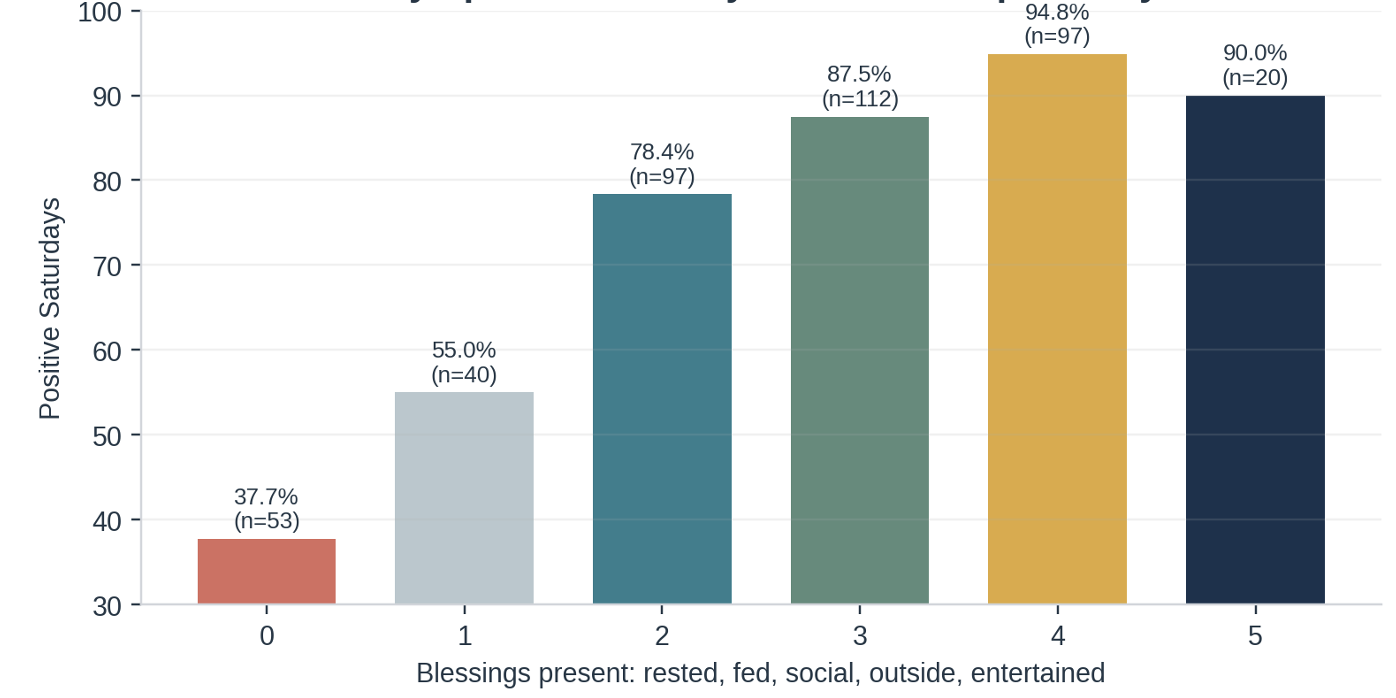 Apparently my ideal Saturday just involves a lie-in, a good breakfast, and a meet-up with a friend
- There is also an interesting counter-point - Daylio told me that playing ‘The Sims’ had an incredibly positive effect on my life, with 95.2% positive days! However, when I analysed the data more and controlled for month and weekday, it turned out basically neutral. The game was strongly associated with a happy period, but it did not necessarily create that period.
But my life is so boring!
Firstly, see above. Secondly, some entries are meant to be boring! If you had an incredibly lazy Sunday and just did laundry, that’s okay! Write “lazy sunday, did laundry”. If, years later, you are going through a period where laundry feels impossible, you can look back on boring days and see that you are a person who has had boring days, and can have them again. ‘Boring’ is sometimes a positive. And you wouldn’t know that, if you hadn’t written that down.
Very few of my 6,000 entries are interesting by themselves. Some are, but most are just fragments, a mood, an activity, a bedtime sentence. Together, though, they document friendships beginning and ending, problems gradually gaining and losing importance, and routines being started and stopped. None of those changes were set in stone when I wrote the first entry - and there was no entry labelled: “Here is what I am doing differently now.” They only become visible when I can look backwards across thousands of ordinary days.
How I would start a journal today
-
Keep the minimum entry tiny. Allow yourself to write one sentence, or even a couple of words.
-
Record ordinary things. Write down ‘work’, ‘takeaway’. You don’t need to force something exciting to happen for it to be journal-worthy.
-
Write for yourself. You don’t need to write in an explanatory tone for a potential future reader - write how you are feeling right now.
-
Do not punish yourself for gaps. I have had periods where I missed a week, and filled it back up later. A journal containing dozens of missing days is still infinitely more valuable than a journal you gave up on after a month.
-
Don’t restrict yourself to one entry per day. If something changes, write another one. You don’t have to average yourself!
-
Back it up. This applies whether you’re writing it digitally or physically. Export your data, scan the pages in, back it up. There’s nothing like losing all your journalling history to discourage you from starting again.
I have no idea when I’ll write my 12,000th entry. Most of the next 6,000 will be about random meals, dog walks, arguments, films, and lots and lots of tired mornings. But I know those are the exact days worth writing down.